It’s 2 a.m., and a teenage lady, being worried a few pal factor, lies conscious. Slightly than wake her folks, she alternatives up her telephone, opens an AI app and kinds, “I’m so stressed out, I can’t sleep.”
A answer arrives hastily: “I’m sorry you’re dealing with this. Want to tell me a bit about what is stressing you?” The dialog unfolds, and 20 mins later she is calmer and in a position to sleep. The supportive voice that calmed her? A big language fashion, or LLM, chatbot.
Whilst this can be a hypothetical state of affairs, it represents a quite common development of man-made intelligence use by means of teenagers.
Many teenagers are turning to AI chatbots, which might be designed to simulate empathy and take care of human engagement, for companionship, emotional strengthen and psychological fitness recommendation. Analysis displays that that is increasingly more commonplace, with 72% of teenagers having interacted with AI better half chatbots, and 13% to twenty% having sought strengthen thru AI for emotional considerations in a two-month length in 2025.
In every other fresh find out about, 63% of the kids and younger adults who used an AI chatbot for psychological fitness recommendation had no longer disclosed it to somebody.
As medical psychologists and a kid psychiatrist who paintings with youngsters, we’ve noticed this shift firsthand.
In 2025 we revealed tips for clinicians on deal with teenager chatbot use security, and we’re now running to lend a hand folks and different relied on adults do the similar.
Why teenagers are susceptible
Not like social media platforms, which attach teenagers with friends, AI chatbots corresponding to ChatGPT, Claude and Gemini serve as as simulated dialog companions and partners, providing on-demand responses that may really feel supportive and tasty. Whilst a small choice of purpose-built healing chatbots were studied in managed settings, maximum teenagers are the use of general-purpose gear that had been by no means designed or validated for psychological fitness strengthen. This comprises stand-alone platforms corresponding to ChatGPT and chatbots constructed into apps that teenagers already use, corresponding to Snapchat’s My AI.
Those chatbots are all over the place, extremely out there and hard for teenagers to steer clear of. Teenagers incessantly describe chatbot interactions as emotionally significant or supportive, infrequently even who prefer chatbot conversations to speaking with buddies.
Teenagers, nonetheless forming their sense of self and incessantly yearning social validation, could also be particularly at risk of experiencing those simulated relationships as genuine. This development is occurring in genuine time, and a urgent query is information teenagers to make use of chatbots safely.
Psychological health-focused chatbots vs. overall ones
There may be proof that some healing AI chatbots can lend a hand adults with gentle signs when used along skilled psychological fitness strengthen. Woebot, as an example, an absolutely computerized cognitive behavioral therapy-based chatbot, lowered depressive signs in school scholars after two weeks of use. Some early proof displays attainable for helpfulness for more youthful teenagers as smartly.
However those are specialised gear examined in analysis research — no longer the general-purpose chatbots like ChatGPT that the majority teenagers if truth be told use. Those programs most often lack efficient disaster protocols or pathways to escalate care when any individual is in peril.
A November 2025 Not unusual Sense Media file rated general-purpose chatbots as unacceptably dangerous for teenager psychological fitness strengthen.
Chatbots won’t acknowledge indicators of self-harm or suicidal ideas as an individual would.
Navigating the advantages and dangers
Common-purpose chatbots can generate misguided or deceptive recommendation this is offered with prime self assurance. For some customers, it will create confusion or beef up bad ideals.
Children, particularly the ones experiencing loneliness, nervousness or social-communication demanding situations, would possibly shape robust attachments and switch to chatbots instead of human connection. This will, in flip, distort their expectancies of genuine relationships.
Maximum relating to is how those programs deal with ideas that pose genuine chance to teenagers, together with ideas of dangerous social behaviors, self-harm and even suicide.
Research of chatbot efficiency in detecting and responding to ideas of suicide, by means of each healing and general-purpose chatbots, display insufficient reaction. Even if the chatbots be offering assets just like the 988 Suicide and Disaster Lifeline, a countrywide disaster line, conversations with relating to content material are incessantly approved to proceed with no exhausting prevent.
The security of the interactions has a tendency to degrade over the process lengthy conversations. So 2 a.m. ruminations can turn into even riskier interactions at 3 a.m. as chatbot responses turn into extra chaotic and not more topic to security guardrails.
Court cases filed and settled in 2025-26 have alleged that interactions with language fashions corresponding to ChatGPT resulted in teenager suicidal habits and tragic losses, highlighting that business chatbots lack efficient guardrails and disaster protocols.
Given those considerations, some chatbot systems have instituted restrictions. Personality.ai, as an example, not too long ago banned open-ended chat for customers underneath 18. The app now calls for age verification and lets in folks to decide in to obtain notifications.
On the other hand, many choices exist for teenagers to nonetheless enjoy open-ended chats with AI, and teenagers incessantly bypass safety-oriented restrictions on-line.
Chatbot safeguards have a tendency to head down as teenagers speak with them longer.
Fabio Principe/iStock by the use of Getty Photographs
Purple flags to look ahead to
Oldsters and different relied on adults can also be looking for teenagers’ problematic behaviors, corresponding to:
Spending expanding quantities of time talking to AI partners.
Decreasing effort and time in relationships with circle of relatives, buddies, academics and others.
Appearing misery or irritability when chatbot get admission to is proscribed.
Attaining for chatbot interactions quite than human helps in moments of emotional misery or disaster.
Those patterns reflect problematic social media use by means of teenagers – a trajectory that provides a cautionary lesson.
Huge acknowledgment of social media’s chance got here simplest after harms turned into entrenched; in 2023 the U.S. surgeon overall warned that social media poses a “profound risk of harm” to formative years psychological fitness.
In our evaluate, chatbots pose a related chance, and early consciousness is the most important.
How folks and relied on adults can lend a hand
Probably the most tough step is easy: Communicate with teenagers about their chatbot use.
Drawing near teenagers with interest and nonjudgment is useful.
It is smart to think an adolescent is the use of a chatbot, as a result of that is in all probability the case. Slightly than a closed-ended query like “Do you talk to chatbots?” which some teenagers would possibly understand as judgmental, adults can start with open-ended questions like “When you use chatbots like ChatGPT, what do you talk about?”
Further element can also be accumulated from questions like “Has anything ever felt uncomfortable, confusing or surprising?” or “How do you use chatbots or AI companions when you are feeling upset or overwhelmed?”
Many teenagers can really feel relieved that oldsters are keen to speak about this overtly, quite than disregarding or banning it outright. Oldsters can use what they be informed in those conversations to offer steerage.
Environment barriers for protected use
As households set barriers round display time and social media, they may be able to come with chatbot use as smartly. Closing dates, specifically past due at night time when teenagers could also be extra emotionally susceptible, can also be useful. Oldsters and teenagers will have to come to transparent agreements about when chatbots will have to no longer be used, specifically all the way through moments of disaster or prime misery.
It may be helpful to check get admission to human helps, corresponding to a relied on pal, a dad or mum, a college counselor or the 988 Suicide & Disaster Lifeline. You’ll additionally analysis choice emotional-regulation tactics, corresponding to journaling, distraction, grounding and respiring tactics.
Common check-ins about how chatbot use goes and whether or not considerations are bobbing up can stay knowledge flowing and reinforce security. The purpose isn’t essentially to do away with chatbot use however to set considerate barriers that give protection to reference to genuine folks and cut back the chance of unsafe interactions.
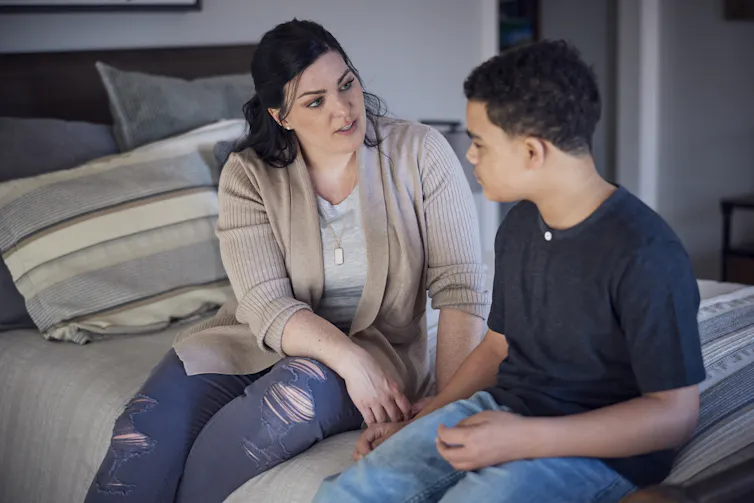

Oldsters speaking with their youngsters about chatbot use can lend a hand make sure more secure interactions.
Lock Inventory/DigitalVision by the use of Getty Photographs
Key issues for AI literacy
Our medical tips emphasize serving to teenagers perceive what chatbots are and aren’t. Oldsters can beef up this as smartly.
Necessary subjects to speak about with teenagers come with:
Chatbots don’t “know” folks; in interactions, they’re predicting responses in response to patterns within the chat. Subsequently, any sense of working out, connection or empathy – then again convincing – is simulated, no longer genuine.
Chatbots could make errors or fully make issues up – known as “hallucinations” within the AI box – whilst appearing nice self assurance in those inaccuracies.
Chatbots are “tuned” by means of their creators to be agreeable and they have a tendency to inform folks what they need to listen, which may make their outputs much less devoted or much less helpful in real-life contexts.
Chats with chatbots aren’t non-public or privileged, and conversations could also be saved, used to coach long run fashions, reviewed by means of people or surfaced in a knowledge breach.
Speaking overtly about those obstacles is helping teenagers interact extra significantly and safely.
Open traces of conversation
Analysis is simplest starting to emerge round how AI chatbot interactions particularly have an effect on adolescent psychological fitness, however the rising considerations are genuine and vital.
Whilst chatbot interactions are increasingly more tricky for teenagers to steer clear of, supporting teenagers towards more secure use is imaginable. The time to speak with teenagers is now, and those conversations can give protection to their security and deepen their human connections.
Should you or any individual you realize is in disaster and are founded within the U.S., name the 988 Suicide & Disaster Lifeline to talk with a educated listener, or textual content HELLO to 741741. Each products and services are unfastened, to be had 24/7 and confidential. In case you are a reader from out of doors the U.S., please use a helpline like the only above or discuss to a healthcare skilled.