What connects these stories is not fame but timing. Each person happened to be standing at a specific crossroads, and what they did next rippled outward in ways nobody could have predicted. Some paid a steep personal price for it. Others simply went back to their lives, largely unaware of how much the world had shifted because of them.
Rosa Parks refuses to give up her seat

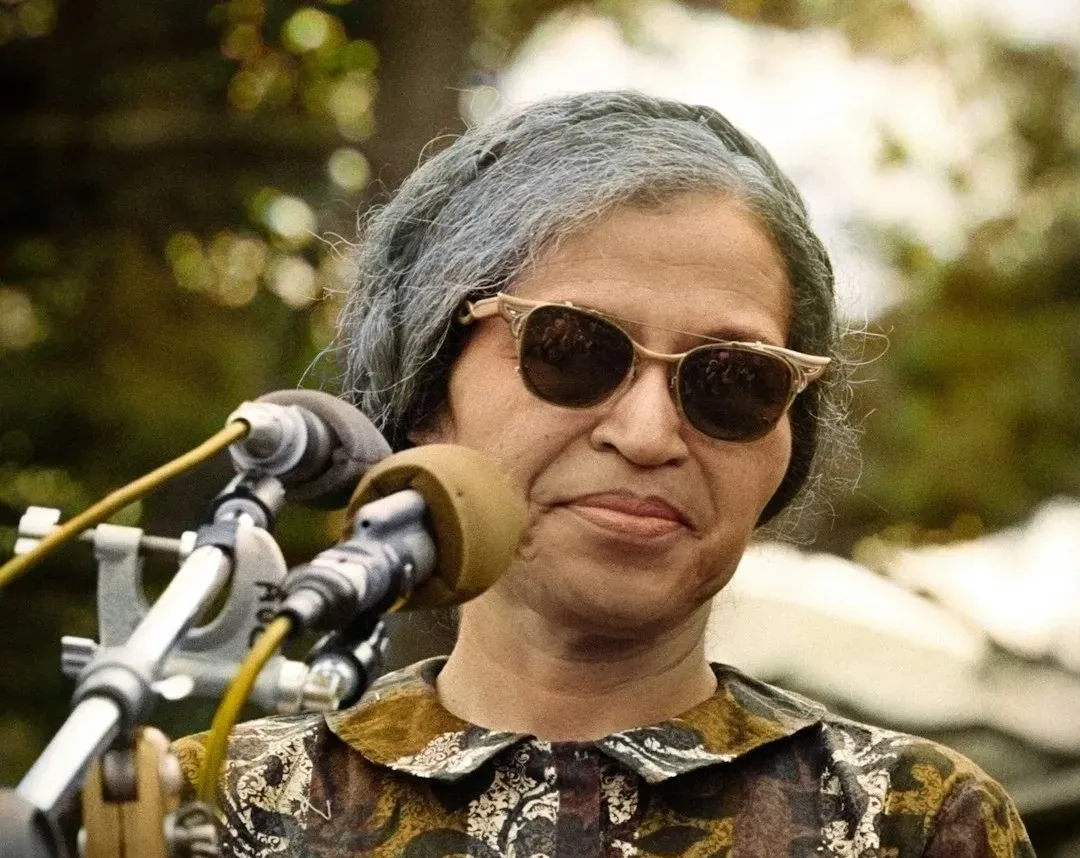
On December 1, 1955, Rosa Parks, a 42-year-old seamstress in Montgomery, Alabama, declined to move from her seat on a city bus when a white passenger wanted it. She was arrested, and her act of quiet defiance became the spark for the Montgomery Bus Boycott, a 381-day protest that crippled the city’s transit revenue and drew a young pastor named Martin Luther King Jr. into national leadership. Parks was not the first Black woman to refuse to give up a bus seat in Montgomery, but her case became the one organizers rallied around, partly because of her standing in the community as an NAACP secretary.
The boycott ended only after the Supreme Court ruled in Browder v. Gayle that Alabama’s bus segregation laws were unconstitutional. Parks lost her job and eventually left Alabama for Detroit, living for decades afterward largely out of the spotlight she had unintentionally created. Her decision, made in a moment of exhaustion rather than grand strategy by her own later accounts, remains one of the clearest examples of how one person’s refusal to comply can reorganize a movement around itself.
Claudette Colvin’s earlier, less remembered stand

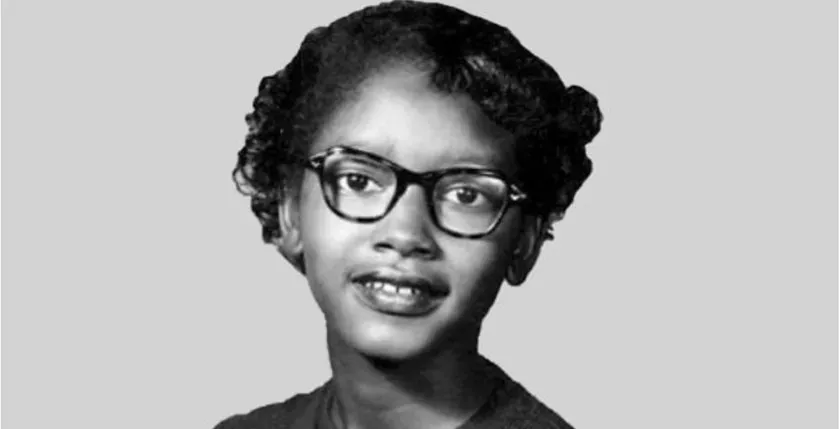
Nine months before Rosa Parks made headlines, a 15-year-old named Claudette Colvin was arrested in Montgomery for the same offense: refusing to surrender her bus seat to a white passenger. Colvin was pulled off the bus, handcuffed, and taken to jail, becoming one of the first people to challenge bus segregation through the courts. Civil rights leaders at the time considered her case less useful for a public campaign, partly because of her age and a pregnancy that followed soon after, so her story faded from the spotlight that later found Parks.
Colvin’s case was not forgotten by lawyers, however. She became one of four plaintiffs in Browder v. Gayle, the federal lawsuit that ultimately led the Supreme Court to strike down Montgomery’s segregated bus system. For decades she lived quietly in the Bronx, largely unrecognized, until historians and journalists in the 2000s began giving her a more prominent place in the story of the civil rights movement.
Vasili Arkhipov says no to a nuclear launch

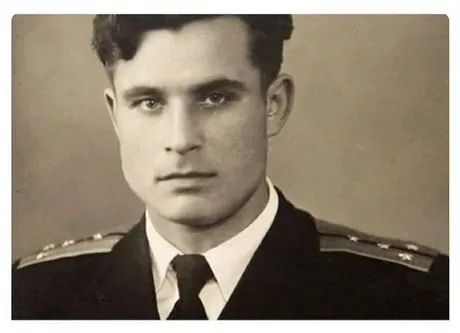
During the most dangerous days of the Cuban Missile Crisis in October 1962, a Soviet submarine called the B-59 found itself surrounded by American destroyers dropping depth charges to force it to surface. The temperature inside the submarine reached 37 degrees Celsius, the air conditioning had failed, and sailors had been fainting in the stifling air as Captain Savitsky decided to arm the submarine’s nuclear torpedo. Launching required agreement from all three senior officers aboard, and the vote was two to one in favor of firing a nuclear torpedo at the American aircraft carrier group overhead, with the sole dissenting vote belonging to Vasili Arkhipov.
Arkhipov was not even the submarine’s captain. He was the flotilla chief of staff who happened to be aboard, and protocol on that particular vessel required unanimous agreement among the three senior officers before the weapon could be released. His refusal, delivered under enormous pressure and with no way to confirm whether war had already broken out on the surface, is widely credited with preventing a nuclear exchange that could have escalated far beyond Cuba. Arkhipov died in 1998, four years before his role became widely known through declassified records, and never lived to hear himself described as the man who saved the world.
Stanislav Petrov trusts his instincts over the machine

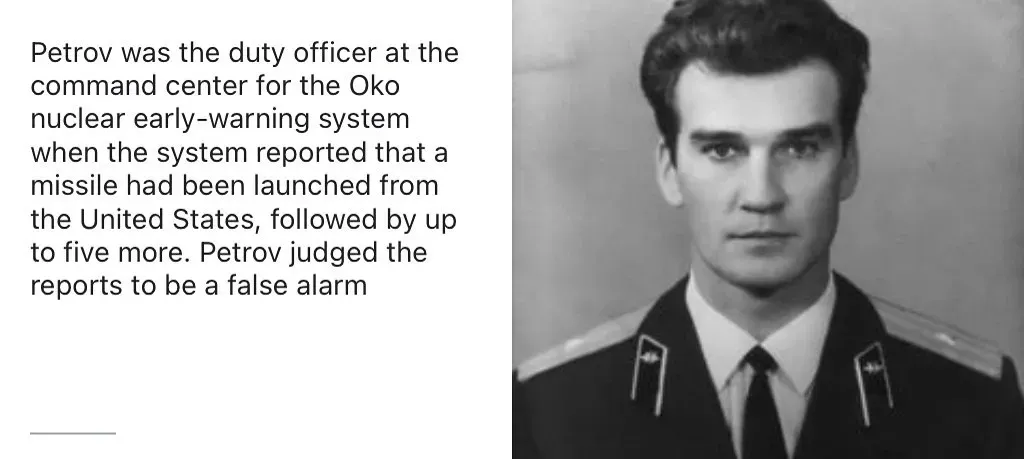
Two decades later, another Soviet officer faced a similarly narrow window to prevent catastrophe, this time from inside a bunker rather than a submarine. On the evening of September 26, 1983, Stanislav Petrov took his seat for a shift at the Serpukhov-15 command center near Moscow, where a top-secret system analyzed satellite data for signs of an American missile launch. Partway through his shift, the system reported that five missiles had been launched from the United States.
Protocol called for Petrov to immediately alert his superiors, a step that would likely have triggered a retaliatory strike. Instead, he judged the alert to be false, reasoning that a genuine American attack would involve far more than five missiles, and he was correct, since the satellites had mistaken sunlight reflecting off high altitude clouds for missile launches. He chose to wait for corroborating evidence that never arrived rather than passing the warning up the chain of command, a decision credited with preventing a retaliatory nuclear strike against the United States and its NATO allies. He received no medal at the time, and the incident stayed classified for years, largely because Soviet officials were embarrassed by the failure of their own warning system.
Mohamed Bouazizi and the spark of the Arab Spring

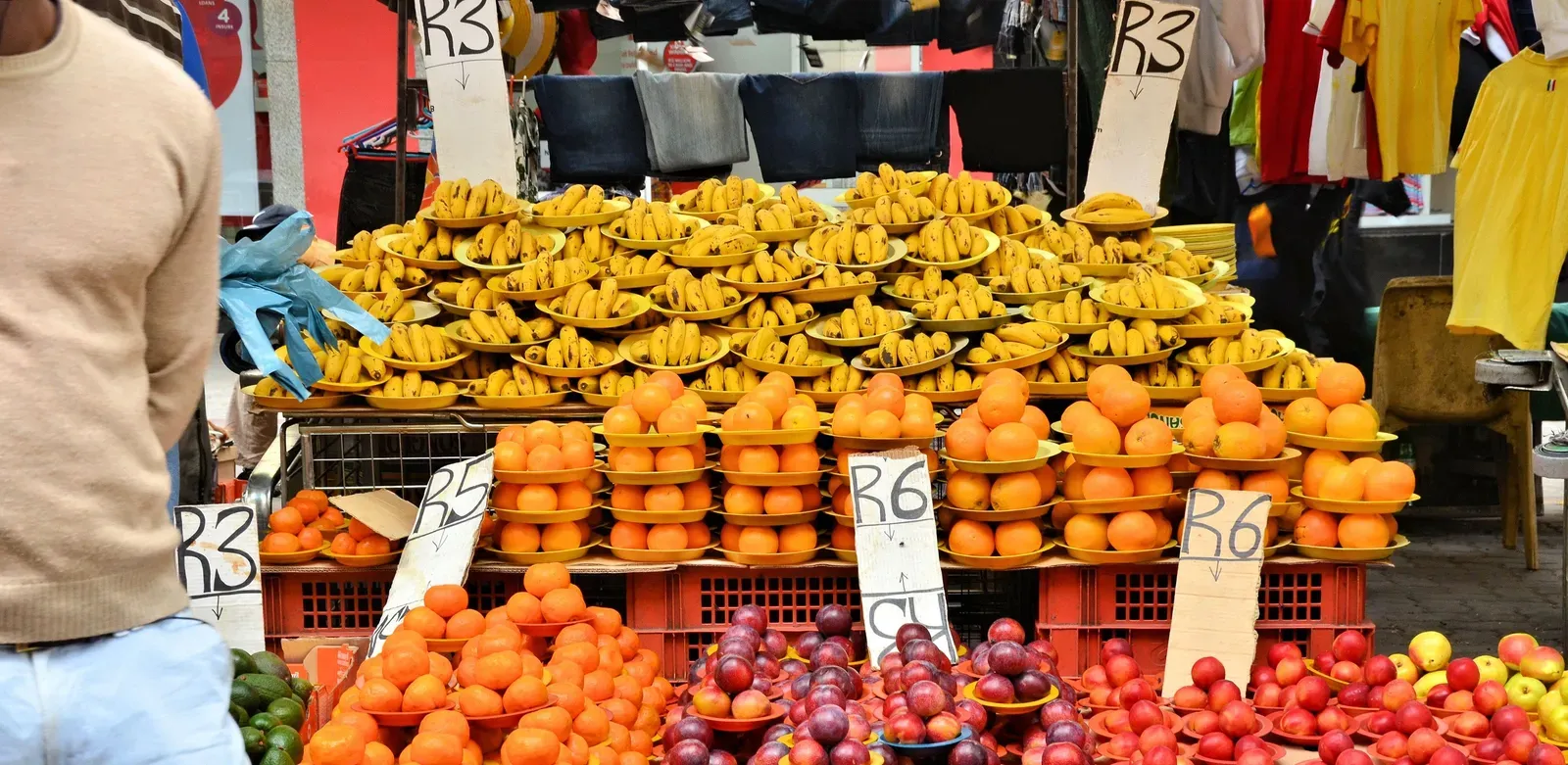
On December 17, 2010, a 26-year-old fruit vendor in the Tunisian town of Sidi Bouzid set himself on fire outside the local governor’s office. Market inspectors had confiscated his wares that morning, claiming he lacked the necessary permit, and after being publicly humiliated by an official and denied a hearing with the governor, Bouazizi acted out of desperation. He died from his injuries on January 4, 2011, but by then his act had already ignited protests that spread far beyond his hometown.
His cousin filmed the aftermath and uploaded the footage, which Al Jazeera broadcast that same evening, helping the story travel across Tunisia within a day. By the next day, protests had erupted in cities across Tunisia, with thousands of young people taking to the streets in Sidi Bouzid and beyond. Within weeks, President Zine El Abidine Ben Ali had fled the country after 23 years in power, and the unrest spread to Egypt, Libya, Syria, and beyond in what became known as the Arab Spring.
The unnamed man who stood before the tanks

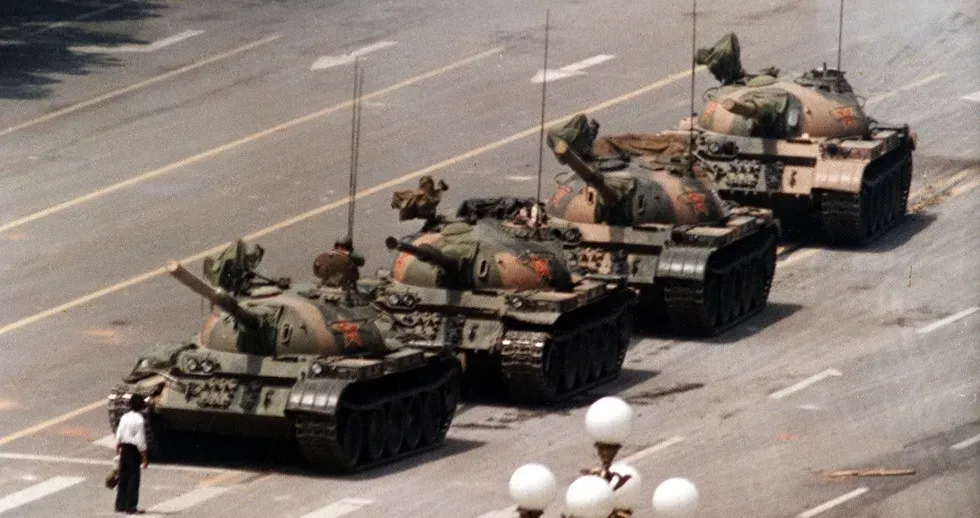
On June 5, 1989, the day after Chinese troops violently cleared pro-democracy demonstrators from Tiananmen Square, a lone man in a white shirt stepped in front of a column of tanks moving down Chang’an Avenue in Beijing. He carried what appeared to be shopping bags and stood his ground as the lead tank tried to maneuver around him, matching its movements each time until it finally stopped. Photographers and news crews watching from nearby hotel balconies captured the image, which was transmitted around the world within hours.
The man was eventually pulled away by bystanders, and his identity, along with his fate, has never been confirmed by Chinese authorities. The photograph became one of the most recognized images of the twentieth century, a symbol of individual defiance against overwhelming state power that circulated globally even as the Chinese government worked to suppress discussion of the crackdown at home. Decades later, the image remains heavily censored within China, which only underscores how much authorities still consider it dangerous.
Phan Thị Kim Phúc and the photograph that shifted a war


In June 1972, a nine-year-old girl named Phan Thị Kim Phúc ran down a road in Trảng Bàng, South Vietnam, after a napalm strike hit her village, her clothes burned away and her body severely injured. Associated Press photographer Nick Út captured the moment on film, and the image ran on front pages across the world within a day, becoming one of the defining photographs of the Vietnam War. Kim Phúc herself had no control over the photograph’s existence or its impact, yet her image did more to shift American public opinion against the war than many official reports or political speeches.
She spent over a year in hospitals recovering from third-degree burns covering much of her body and endured dozens of surgeries in the years that followed. Kim Phúc later became a UNESCO goodwill ambassador and has spent decades speaking publicly about peace and reconciliation, turning an image she never asked to represent into a platform for advocacy. The photograph itself won the Pulitzer Prize and continues to be taught as one of the clearest examples of how a single frame can alter public sentiment on a war already underway.
Sophie Scholl and the White Rose leaflets

Sophie Scholl was a 21-year-old university student in Munich when she joined her brother Hans and a small group of friends in producing anti-Nazi leaflets under the name the White Rose. Between 1942 and 1943, the group distributed pamphlets calling for resistance against Hitler’s regime, appealing to German citizens’ conscience at a time when open dissent could mean death. Scholl and her brother were caught distributing leaflets at the University of Munich in February 1943, arrested by the Gestapo, and executed by guillotine just days after a show trial.
She was not a soldier, a politician, or anyone with institutional power, just a student who believed silence made her complicit in the regime’s crimes. Her final recorded words before execution reflected a conviction that others would eventually act on what she had started, even if she would not live to see it. Decades later, Scholl remains one of Germany’s most honored historical figures, with schools, streets, and a square outside the University of Munich named after her and the White Rose group.
Mamie Till-Mobley’s decision to open the casket


In August 1955, 14-year-old Emmett Till was brutally murdered in Mississippi after being accused of offending a white woman in a local store. When his body was returned to Chicago, his mother, Mamie Till-Mobley, made the decision to hold an open-casket funeral, insisting that mourners and the press see exactly what had been done to her son. Photographs of Till’s disfigured body ran in Jet magazine and other Black publications, reaching an audience far beyond Chicago within weeks.
Till-Mobley’s choice transformed a private tragedy into a public reckoning, exposing the brutal reality of racial violence in the American South to people who had previously been able to look away. Historians and civil rights figures, including Rosa Parks herself, later cited the Till case as a catalyst that hardened resolve within the broader movement. Till-Mobley spent the rest of her life as an educator and advocate, insisting that her son’s death not be allowed to fade from public memory.
Darnella Frazier and ten minutes of cellphone footage

On May 25, 2020, a 17-year-old named Darnella Frazier was walking to a Minneapolis convenience store with her young cousin when she saw police officers restraining a man on the ground. She pulled out her phone and recorded a 10 minute and 9 second video of police officer Derek Chauvin kneeling on George Floyd’s neck as Floyd pleaded for his life. That footage, uploaded to Facebook within hours, contradicted the initial police account of Floyd’s death and became central evidence in the murder trial that followed.
The video spread globally and helped ignite a wave of protests against police brutality that reached cities across the United States and beyond. The Pulitzer Prize board later awarded Frazier a special citation for courageously recording the murder of George Floyd, a video that spurred protests against police brutality around the world, highlighting the crucial role of citizens in journalists’ quest for truth and justice. Frazier herself later said she recognized another human being suffering and in pain, even though she didn’t personally know Floyd, which is what prompted her to keep recording despite how disturbing the scene was.
These ten stories share little in common on the surface. A submarine officer in 1962 has almost nothing in common with a teenager holding a phone camera in 2020. Yet each of them faced a moment where the easier choice was to look away, stay quiet, or follow orders, and each chose otherwise. History tends to remember the outcomes more than the individuals who caused them, but these names are worth holding onto precisely because they remind us that historical turning points rarely announce themselves in advance. They simply arrive, and someone has to decide what to do next.